The Real Meaning of Holi:Why We Throw Colours
Based on ancient Sanskrit texts, Ayurvedic science, and 2,300 years of preserved wisdom, we throw colours, light bonfires, and eat sweets. But do you know why? The real story of Holi is far more interesting than the version most people know, and it begins with a single word.
No audio available
Author: Eshan Singh
Published: 03 March, 2026
The Name "Holi" Does Not Come From Holika
Most people think Holi is named after Holika, the demoness. It is actually the other way around. The word found in the ancient Sanskrit dictionary Shabdakalpadrum
होलक:, पुं, (हु+विच्। लक्ष्यते आखाद्यते इति। लक्+अप्।)
तृणाग्निभृष्टार्द्धपक्कशमीधान्यम्।
This means Grain or legumes that are half-roasted in a fire of dry grass. Holāka = half-roasted barley in a sacred fire.
The festival was named after this one act: roasting the first grain of the new harvest in a communal fire. The full original name was Vasanti Navasasyeshti, meaning "the spring fire-ritual for the new crop." This is a harvest festival that got dressed up in mythology over thousands of years.
वासन्ती नवसस्येष्टि
The Timing Is Not a Coincidence
Holi falls at the Phalguna full moon, late February or early March. This is the exact moment winter ends and summer begins. Our ancestors noticed that this seasonal switch is when diseases spread fastest. Immunity dips. Children get sick. Bacteria multiply in the shifting temperatures. The Atharvaved even names five types of disease-causing organisms, calling one type adrishta, meaning "the invisible ones"
अ॒ल्गण्डू॒न्त्सर्वा॑न्छ॒लुना॒न्क्रिमी॒न्वच॑सा जम्भयामसि
Atharved 2.31.2 says, "We crush and destroy insects and germs of diseases, those that are visible or invisible, creeping ones as caterpillars, bugs in beds, fast running ones and those that ramble around". Holi was built to protect people at exactly this dangerous moment.
The Roasted Grain Was Medicine
The ancient Ayurvedic text Bhavaprakasha describes exactly what happens when you eat Holāka:
होलकोऽल्पानिलो मेदःकफदोषत्रयापहः
Bhavaprakasha, Chapter 12, verse 156 says, Holāka reduces Vata (bloating), reduces excess fat (Meda), clears Kapha (phlegm), and balances all three doshas.
After three months of cold, heavy winter food, the body is full of Kapha: congestion, sluggishness, and phlegm. Half-roasted barley eaten at Holi was the prescribed Ayurvedic reset for the new season. Modern science agrees: barley is rich in beta-glucan fiber, confirmed to reduce cholesterol, improve gut health, and support immunity.
Ancient texts also commanded this ritual before eating from the new harvest at all:
नानिष्ट्वाग्रयणेन नवस्याश्नोगात्
Manava Grihyasutra 2.3.9 says, "Do not eat the new grain without first performing the sacred fire offering".
The Bonfire Was a Sweat Treatment
The Charaka Samhita, Bharat's oldest medical text, lists thirteen types of Sweda Karma (sweat treatments for expelling illness). One of them is called Holāka: burning dried heap of dung cakes(of elephants, cows etc) and medicinal material to generate therapeutic heat around the body. These sweating methods help in relieving cold, pain, digestive diseases etc.
At a Holi bonfire, people burn the same dried cow-dung cakes, sometimes with ghee and flowers added. They stand around the fire. They sweat. The heat rises to 50-60 degrees Celsius nearby, killing airborne pathogens.
This is not a coincidence. The communal Holi bonfire may have been a community-scale version of the Charaka Samhita's Holāka sweat treatment, disguised as a festival so everyone would participate.
Three Myths. One Hidden Message.
There are three widely cited Holi narratives, and when examined together, the structural symmetry is difficult to ignore. In the account of Prahlad and Holika from the Bhagavat Puraan (Chapter 7), Holika approaches in disguise and attempts to kill a child, only to be destroyed by fire.
In the story of King Raghu and Dhundha from the Bhavishya Puraan, an invisible demoness specifically terrorizes children and is driven away through bonfires, loud communal noise, and ritual burning of cow dung.
Similarly, in Chapter 10 of the Bhagavat Puraan, the demoness Putana disguises herself to attack the infant Kṛṣṇa, and her defeat becomes the basis for collective celebration. Across all three narratives, the pattern is consistent:
A hidden or deceptive threat targeting children, neutralized through fire and coordinated community response. One interpretive lens suggests that these demons symbolically represent seasonal pathogens that disproportionately affected children during the winter to spring transition. From this perspective, the myths function not merely as theological stories but as encoded public health rituals, ensuring that preventive practices such as bonfires, fumigation like burning, and communal mobilization were repeated annually through the vehicle of tradition.
Why Is Holika Both Villain AND Goddess?
Here is the question nobody can explain: Holika is the villain, yet people in many parts of Bharat also worship her for the health and protection of their children. How?
Because in the older tradition, Holika was not a demon at all. She represented the outer husk of the barley grain that burns in the fire, while Prahlad represented the inner grain that survives and feeds the village.
We burn the husk to release the food. We honour the grain because it keeps our children alive. She is both burned and worshipped because she is both the sacrifice and the nourishment.
होलिकामाहात्म्यम्
The Holikamahathyam, a Shakta tradition text, goes further: in this version Holika is not a villain at all. She is an incarnation of the Mother Chandika who kills a demon named Virasen on this night. The bonfire burns the demon's effigy, not hers.
The Colours Were Herbal Medicine
Original Holi colours were made from:
- Yellow (turmeric): Confirmed antimicrobial and anti-inflammatory. Applied to the whole body at peak disease season.
- Green (neem): Kills skin bacteria and fungi. Supports the gut, skin, and oral microbiome.
- Red (Tesu flowers, Butea monosperma): Cooling and skin-soothing.
- Blue (indigo): Anti-inflammatory properties.
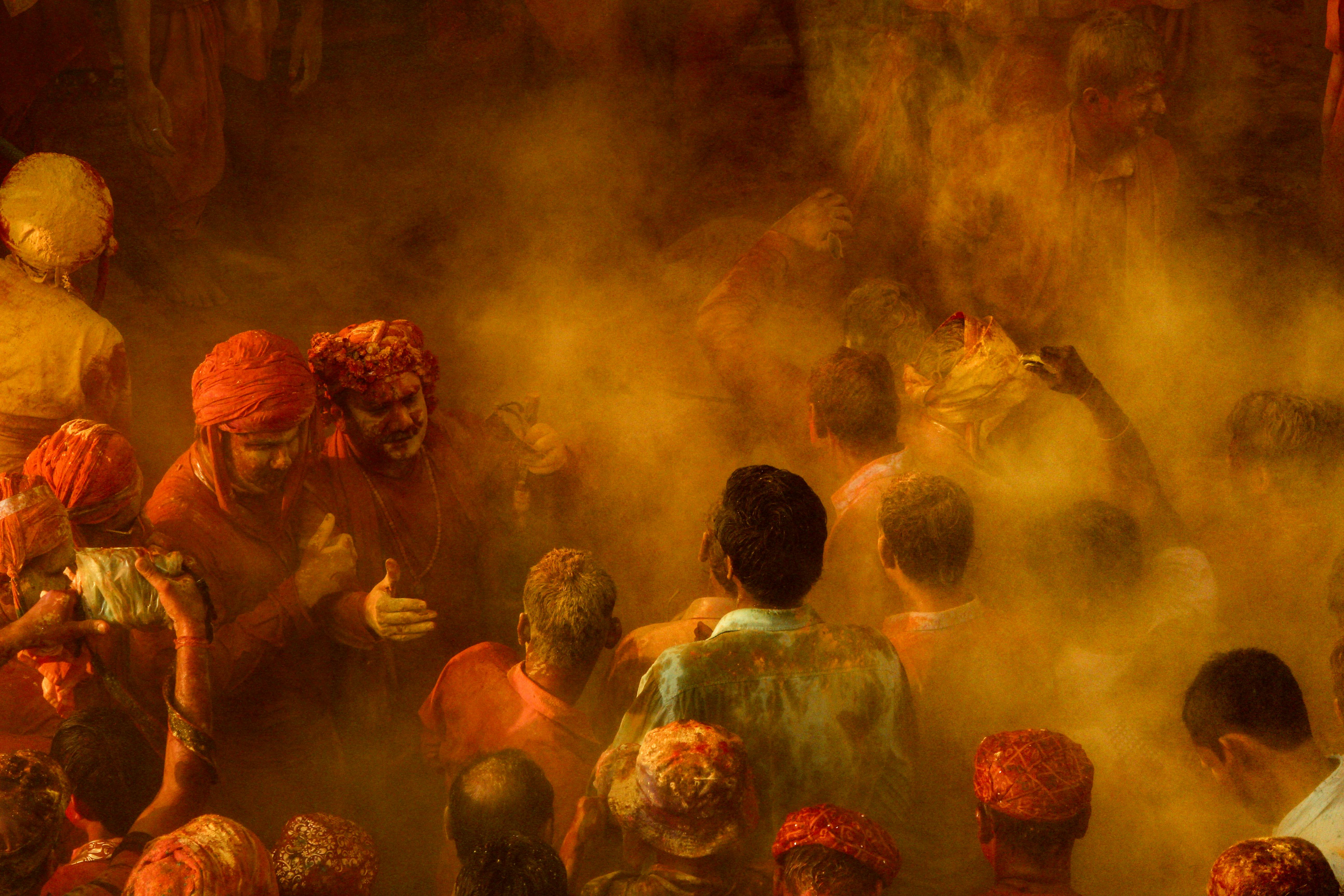
Playing Holi with these natural pigments was essentially applying a full-body herbal treatment, then washing it off to strip away winter's accumulated grime. The synthetic chemical colours used today, containing lead, chromium, and arsenic, are the exact opposite of what Holi was designed to do.
How Old Is This?
The evidence stretches back a very long way:
- Ramgarh Stone Inscription (approx. 300 BCE): Physical carved proof of Holikotsava. Over 2,300 years old.
- King Harsha's Ratnavali (7th century CE): Specifically names Holikotsava in a royal Sanskrit drama.
- Hampi Temple Reliefs (14th to 16th century CE): Eight carved stone panels at a UNESCO World Heritage Site show women with water squirts, musicians, dancers, and festive colour play.
The Real Holi in Three Sentences
Night before: Light a bonfire from cow-dung cakes and wood. Stand near it. The heat is medicine, the smoke purifies the air, and the fire offers gratitude to the sacred for the new harvest.
Morning of Holi: Roast the first barley of the new crop in that fire. Eat it. This is Holāka, the Ayurvedic seasonal reset, and the food that gave the festival its name.
During the day: Cover each other in turmeric, neem, and flower pigments. Wash it off. You have just applied herbal medicine to your whole body and shed the skin of winter at the same time.
What We Have Lost
The natural herbal colours are gone, replaced by chemical dyes that harm skin and eyes. The Holāka grain ritual has nearly vanished. Almost nobody who celebrates Holi today has ever heard the word Holāka.
And yet Holi still draws people together every year around a fire, at exactly the right moment in the calendar, doing roughly the right things for reasons they cannot quite explain but somehow feel.
That instinct is two thousand years of memory.
Bura na mano, Holi hai!